
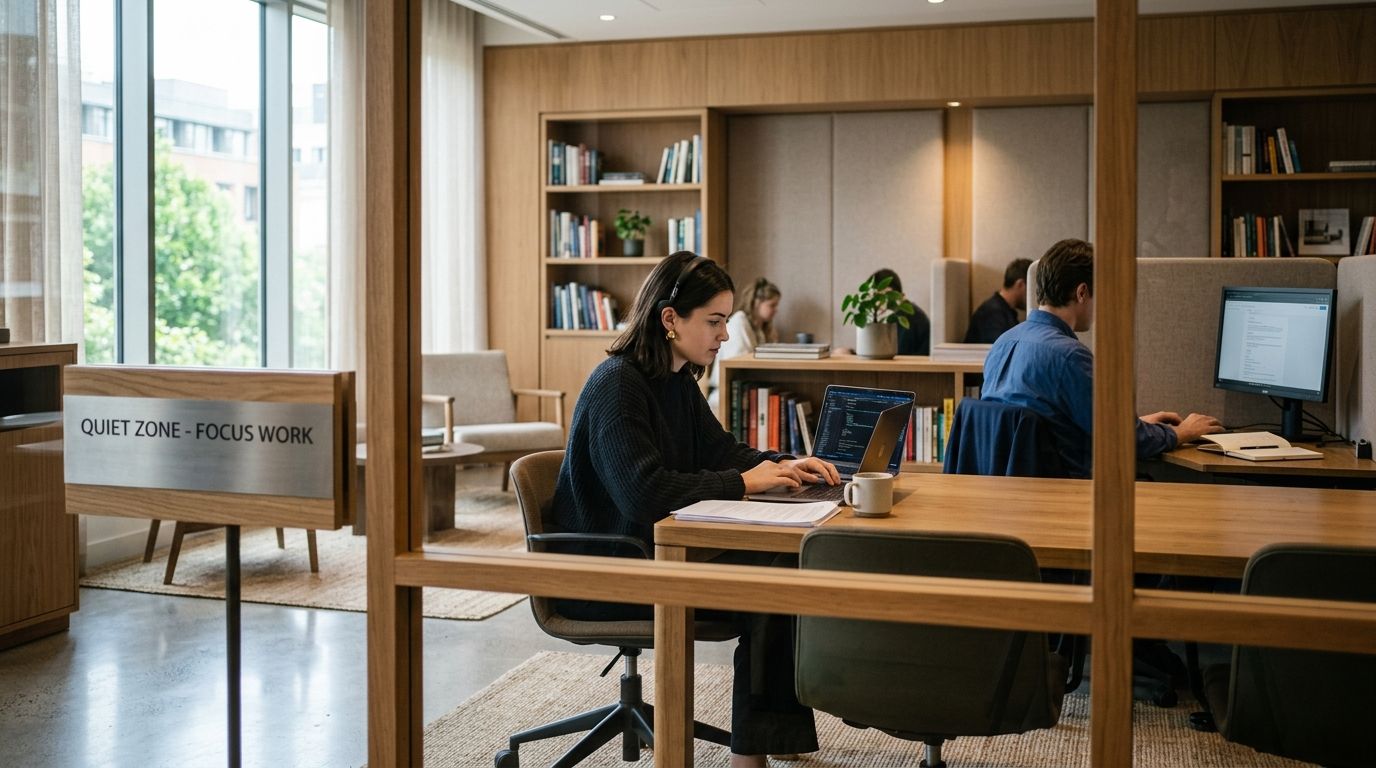
A coworking space with quiet zones is the difference between finishing a report in one sitting and losing an hour to someone's speakerphone call three desks over. Westend Business Hub in Werribee, Victoria runs five distinct formats built for different levels of quiet — private offices, phone booths, a dedicated desk plan, meeting rooms and day passes — and this guide ranks each one against a specific kind of focused work, not against each other on price.
- Best overall for full-day deep work: the private office at Westend Business Hub.
- Best for quick private calls: the phone booths, no room booking required.
- Best for a consistent quiet seat: the dedicated desk plan for solo founders.
- Best for pre-pitch prep: the meeting room, not built for daily solo focus.
- Best for occasional use: the day pass, with no monthly commitment.
Why "quiet zone" claims matter in 2026
Open-plan coworking sold itself on energy and networking for a decade, and that's still true for the main floor at most sites. But in 2026, a growing share of Werribee's coworking demand comes from people who need three or four uninterrupted hours, not a coffee chat — bookkeepers closing month-end, contractors on video calls, writers on deadline.
A coworking space with quiet zones has to solve for that without turning into a library. The format matters more than the building — a phone booth and a private office both sit inside the same site but serve completely different focus needs.
What makes the best coworking space with quiet zones
- Acoustic separation from the main floor — walls or booth panels, not just a corner desk
- Booking consistency — the same desk, booth or room each visit, not a lottery
- Distance from high-traffic zones — away from the kitchen, reception and printer queue
- Extended access hours — early-morning or evening blocks when the floor is empty
- Furniture built for long sessions — proper chairs and desk height, not lounge seating
- Flexible booking windows — quiet time you can grab for an hour or hold for a month
“If you can hear someone's keyboard from across the floor, the zone isn't quiet enough.”
Coworking space with quiet zones at Werribee: at a glance
| Format | Best for | Standout feature | Key limitation |
|---|---|---|---|
| Private Office | Full-day deep work for a team | A closed door, zero interruptions | Highest commitment of the five formats |
| Phone Booths | Private calls, short focus bursts | No advance booking needed most days | Not built for multi-hour sessions |
| Dedicated Desk | A consistent quiet seat, solo founders | Same desk every visit | Still shares floor ambience |
| Meeting Room | Prep before a client presentation | Enclosed, bookable by the hour | Not designed for daily solo work |
| Day Pass / Hot Desk | Occasional quiet sessions | No ongoing commitment | Seat location isn't guaranteed |
1. Private Office at Westend Business Hub: best for full-day deep work
A private office gives a small team its own enclosed room inside the Werribee site, separate from the shared floor and its noise. It suits teams that need a closed door for client calls, sensitive documents or simply four straight hours without someone walking past.
Private Office pros:
- Full acoustic separation from the main coworking floor
- Room for a small team, not just one desk
- Predictable, lockable space for equipment and files
Private Office cons:
- The biggest step up in commitment on this list
- Overkill for a solo worker who only needs quiet occasionally
The private office for small teams of two to five plan at Westend Business Hub is built for exactly this brief. Best for: small teams that need a closed door every working day. Verdict: Buy if daily deep work is non-negotiable for your team.
2. Phone Booths at Westend Business Hub: best for private calls and short focus bursts
Phone booths solve a narrower problem than a private office: a 20 to 40-minute window where you need to hear and be heard without broadcasting to the floor. They're built for calls, quick video meetings and short stretches of concentrated writing.
Phone Booths pros:
- Available without booking a full room
- Enough sound separation for a client call
- Fast to duck into between floor-desk sessions
Phone Booths cons:
- Not designed for multi-hour work blocks
- Limited desk space for spreading out documents
The coworking spaces with phone booths for private calls page covers how the booths at Westend Business Hub fit into a day-to-day workflow. Best for: anyone who needs quiet in bursts, not all day. Verdict: Buy for call-heavy roles; Skip if you need sustained deep work.
3. Dedicated Desk at Westend Business Hub: best for a consistent quiet seat
A dedicated desk gives a solo founder or freelancer the same seat every time, positioned away from the busiest walkways on the floor. It's the middle option between a fully enclosed office and an open hot desk that changes location daily.
Dedicated Desk pros:
- Same seat, same setup, every visit
- Cheaper commitment than a private office
- Consistent enough to build a routine around
Dedicated Desk cons:
- Still shares general floor ambience with the rest of the site
- No door to close for a private call
Dedicated desk plans suit solo entrepreneurs who want quiet without paying for an enclosed room. Best for: solo founders who work from the same spot daily. Verdict: Buy if routine matters more than full isolation.
4. Meeting Room at Westend Business Hub: best for pre-pitch prep
A meeting room isn't a daily quiet-work format — it's an enclosed space booked by the hour for rehearsing a presentation, running a client walkthrough or finishing prep work that needs total privacy for a limited window.
Meeting Room pros:
- Fully enclosed, no floor noise at all
- Video conferencing setups suited to client-facing work
- Booked in short blocks, not a monthly lock-in
Meeting Room cons:
- Not economical for daily solo focus work
- Availability depends on booking demand from other members
Meeting room hire at Westend Business Hub is built around presentations and pitches, not routine desk work. Best for: the two hours before a client meeting, not the rest of the week. Verdict: Buy for occasional high-stakes prep; Hold for everyday quiet.
5. Day Pass / Hot Desk at Westend Business Hub: best for occasional quiet sessions
A day pass covers the reader who needs a quiet coworking space with quiet zones once or twice a month, not every week. It's the lowest-commitment format on this list and the easiest one to try before upgrading.
Day Pass pros:
- No ongoing membership required
- Enough to test the site before committing further
- Cheapest way to escape a noisy home office for a day
Day Pass cons:
- Seat location on the floor isn't guaranteed
- Least acoustic separation of the five formats
The day pass options for occasional coworking use page details how this works at Westend Business Hub. Best for: occasional users testing whether quiet coworking suits them. Verdict: Buy for occasional need; Wait if you already know you need daily quiet.
Find your quiet-work fit
Compare flexible office formats before you commit to one.
How this list is ranked
Each format on this list is weighed against the six criteria above: acoustic separation, booking consistency, distance from foot traffic, access hours, furniture built for long sessions, and how flexible the booking window is. A private office scores highest on separation but lowest on flexibility; a day pass flips that order entirely. Neither is wrong — they answer different questions.
Which coworking space with quiet zones should you choose?
If your team needs a closed door every working day in 2026, the private office is the default answer — nothing else on this list matches its acoustic separation. If you only need quiet in short bursts for calls, the phone booths cover that without the commitment. Solo founders who want a routine without a full office should start with the dedicated desk, and anyone unsure should try a day pass before signing up for anything longer.
FAQ
What is a coworking space with quiet zones?
It's a coworking site that separates focus-friendly areas — private offices, phone booths, or fixed desks — from the open, higher-traffic parts of the floor. Westend Business Hub in Werribee runs five such formats in 2026, each suited to a different kind of quiet work.
Is a private office quieter than a dedicated desk?
Yes, a private office has a closed door and full acoustic separation, while a dedicated desk still sits on the shared floor. Choose the office if you need zero interruptions daily; choose the desk if a consistent seat is enough.
Can I use a phone booth for a full workday?
Phone booths are built for calls and short focus bursts of 20 to 40 minutes, not multi-hour sessions. For a full day of quiet work, a dedicated desk or private office fits better.
Do I need a membership to try a quiet coworking space?
No — a day pass at Westend Business Hub lets you test the site without a monthly commitment. It's the lowest-risk way to see if quiet coworking suits your workflow before upgrading in 2026.
Are meeting rooms good for daily focused work?
Meeting rooms are built for hourly bookings like client presentations and pitch prep, not for everyday solo work. Booking one daily is expensive and often unavailable given other members' demand.
What's the best coworking space with quiet zones for a small team?
A private office is the best fit for a small team that needs sustained quiet together, since it's fully enclosed and holds more than one desk. A shared floor with a dedicated desk works better for a single solo worker.
How do I know if I need a private office or just a quiet desk?
If you need a closed door for client calls or sensitive work every day, a private office is worth it. If occasional quiet is enough, a dedicated desk or day pass covers it at a fraction of the commitment.
One last thing
The format that gets skipped most often on lists like this is the phone booth — it looks like a minor amenity next to a private office, but for anyone doing back-to-back client calls in 2026, it solves the actual daily friction point better than a full room ever will. Start with the cheapest format that solves your specific interruption, not the most impressive one.


