
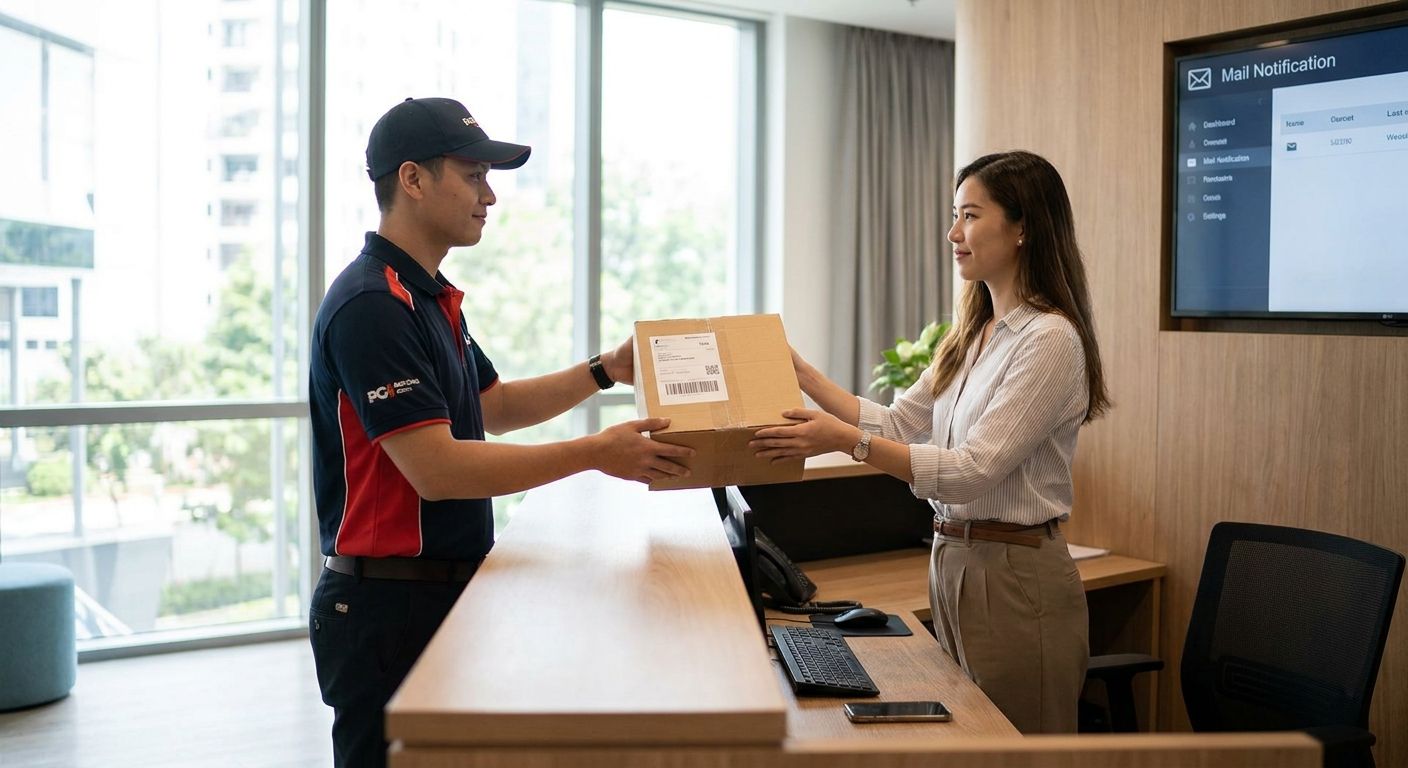
Accepting courier and parcel deliveries at a virtual business address works the same way it does at a physical office: the courier delivers to the street address on file, and the provider's front desk signs for it, logs it, and either holds it for pickup or forwards it to you. The one thing that trips people up is signature-required parcels — not every virtual office plan covers those, so check before you list the address on invoices.
Courier delivery to a virtual business address in 2026 isn't a workaround — it's standard practice for thousands of Australian sole traders and small teams who don't want a courier van showing up at their kitchen table.
- Courier delivery to a virtual business address routes through reception, gets logged, and is held or forwarded — Westend Business Hub handles this at its Werribee address.
- Signature-required and bulky parcels aren't automatically covered by every plan, so confirm this before printing the address on packaging.
- Mail forwarding, scan-and-email, and in-person pickup are the three main handling styles — pick based on how often you need physical items.
- Update the address across couriers, ecommerce platforms, and ABN records at the same time to avoid split shipments.
Why this matters
A virtual address only works for parcels if the provider actually built a mail-handling process around it — a shared office that just "lets you use the address" without a reception desk isn't set up for courier drop-offs. Westend Business Hub's virtual office plans exist specifically so parcels land somewhere staffed, not on a doorstep. Get this wrong early and you end up with returned-to-sender packages, missed AusPost cards, or a courier who refuses to leave a signature parcel unattended.
How do you accept courier and parcel deliveries at a virtual business address?
Follow these steps in order:
- Confirm your virtual office plan includes parcel acceptance — not every plan does, so ask directly rather than assuming.
- Update the address everywhere it needs to appear — supplier accounts, ecommerce platforms, ABN registration, and any packaging or returns labels.
- Ask about signature-required and bulky-item handling — some providers accept standard letters and small parcels but flag large freight or signature-on-delivery items separately.
- Set your collection or forwarding preference — decide upfront whether you'll pick up in person, have items scanned and emailed, or have them physically forwarded.
- Check in regularly — even with notifications, a quick call or visit each week keeps parcels from piling up at reception.
- Notify the provider of expected large or time-sensitive deliveries — a heads-up avoids a courier being turned away because staff didn't know it was coming.
Mail forwarding vs in-person pickup vs scan-and-email
The three handling styles suit different business patterns. Pick based on how often physical items actually matter to your operation, not just what sounds most convenient.
| Handling style | Best for | Trade-off |
|---|---|---|
| In-person pickup | Businesses near Werribee, frequent senders | Requires a visit; not practical if you're interstate |
| Scan-and-email | Document-heavy businesses (contracts, invoices) | Physical parcels still need separate collection |
| Mail forwarding | Businesses that rarely visit in person | Adds a delay of a few extra days versus pickup |
Verdict: if you're within driving distance of Werribee, pickup is the simplest option — it removes forwarding delays entirely. Businesses expanding into Victoria from interstate usually default to forwarding since a physical visit isn't realistic week to week.
This is also where your registered address matters for more than just parcels — it's the same address that should sit on your invoices, your business mail redirection setup, and your supplier accounts, so couriers and Australia Post both recognise it consistently.
Set up mail handling the right way
Get courier and parcel handling sorted before your next shipment arrives.
Why parcel handling policies vary by provider
Not every virtual office treats courier delivery the same way. The differences usually come down to:
- Staffing hours — a reception desk only covers deliveries during the hours someone's actually there to sign.
- Storage space — some providers hold parcels for a set window before requiring pickup; others have more room to hold longer.
- Signature policy — whether staff are authorised to sign for registered or signature-required items on your behalf.
- Parcel size limits — small satchels and envelopes are usually fine everywhere; pallet freight rarely is.
- Notification method — email, SMS, or a phone call when something arrives, which affects how fast you find out.
- Plan tier — basic address-only plans sometimes exclude parcel handling that's bundled into fuller virtual office plans.
Can courier companies deliver to a virtual office in Werribee?
Yes, courier companies can deliver to a virtual office in Werribee the same way they would to any commercial address, since it's a real, staffed location rather than a forwarding-only PO box. The main difference from a home address is that someone is physically present during business hours to accept and sign for the delivery.
Do I need to tell my provider before a courier delivery arrives?
You don't strictly need to, but it helps for large, bulky, or signature-required deliveries. A quick note to reception means staff know to expect it and won't turn the courier away or leave it unsigned.
Can I use a virtual business address for ecommerce returns and supplier deliveries?
Yes, a virtual business address works for ecommerce returns and supplier deliveries in 2026, provided your plan covers parcel acceptance and you've registered the address with your platform and ABN. This is exactly why sellers running a virtual office for ecommerce sellers registering an ABN use the same address for stock returns as they do for invoicing — one address, one point of contact.
What happens if a parcel arrives and I'm not there to collect it?
The parcel gets logged and held at reception if it arrives and you're not there to collect it, then you're notified so you can arrange pickup or forwarding. It doesn't get returned to sender unless it sits well past the provider's holding window without any response from you.
FAQ
Can I receive parcels at a virtual business address?
Yes, you can receive parcels at a virtual business address as long as the plan includes mail and parcel handling. Confirm this with the provider before listing the address anywhere public.
Does a virtual office accept signature-required courier deliveries?
Some virtual offices accept signature-required deliveries and some don't, so it depends on the provider's policy. Ask specifically about signature-on-delivery items, since this is the most commonly excluded category.
How do I redirect courier deliveries to my virtual address?
You redirect courier deliveries to your virtual address by updating the address on supplier accounts, ecommerce platforms, and your ABN registration at the same time. Doing it piecemeal is the main cause of split shipments going to two different addresses.
Is a virtual business address the same as a PO box for parcels?
No, a virtual business address is not the same as a PO box for parcels. A PO box is Australia Post-only and often can't accept courier deliveries from private carriers, while a virtual office is a staffed street address that couriers can deliver to directly.
What happens if my parcel is too large for the provider to hold?
Oversized parcels usually need advance notice so staff can plan storage or redirect the courier, since most providers have limited space for large freight. Check size limits with your provider before ordering anything bulky.
Can I use a virtual address for AliExpress, Amazon, or supplier returns?
Yes, you can use a virtual address for AliExpress, Amazon, or supplier returns provided the address is registered consistently across your accounts. This keeps returns and inbound stock landing at the same staffed location as your other business mail.
One last thing
The parcels that cause the most trouble aren't the big ones — they're the small, signature-required envelopes that couriers won't leave unattended and that sit in a queue if nobody's told reception to expect them. A five-second heads-up before a courier is due beats sorting out a returned-to-sender parcel a week later.


