
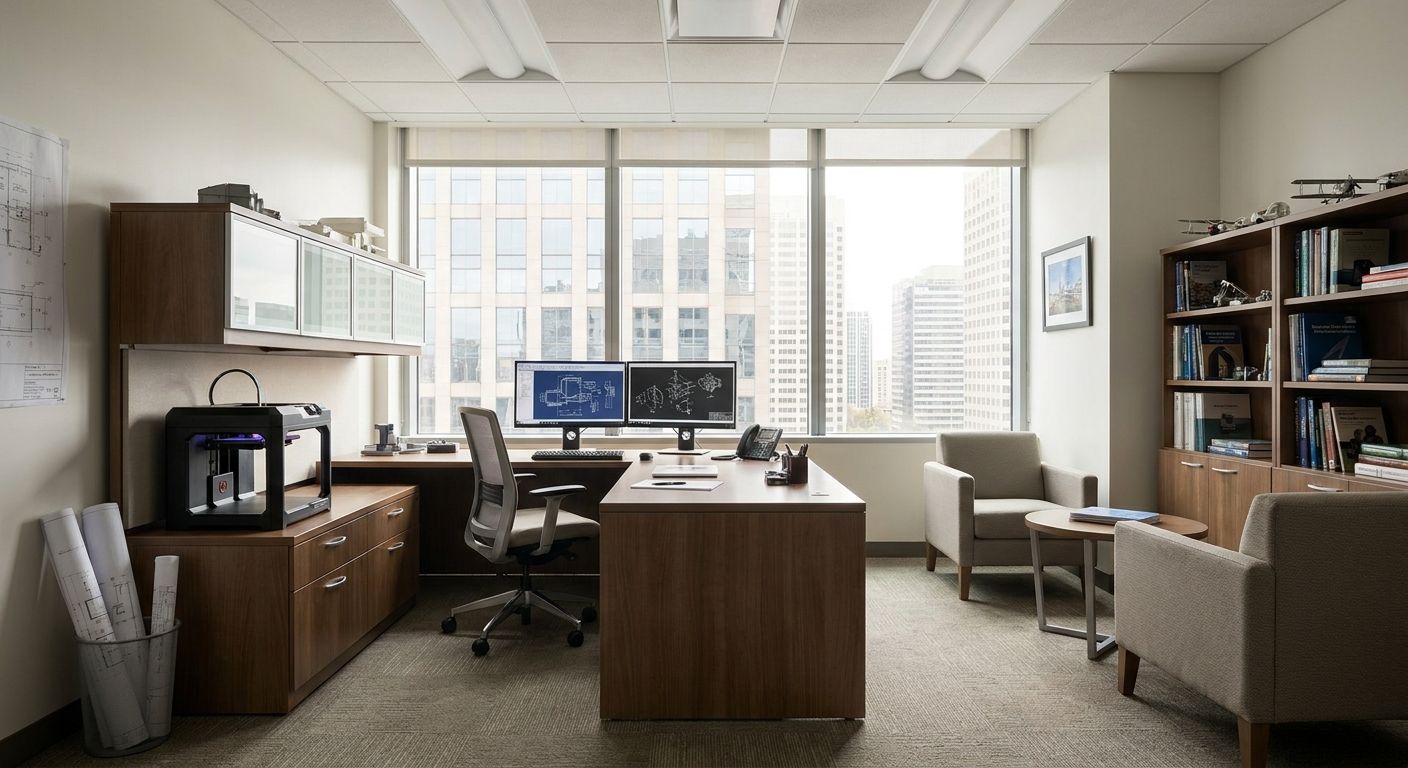
Engineering and technical consultancies need more than a desk with a view — they need room to spread out drawings, run client meetings without background noise, and a business address that looks right on a tender document. This guide breaks down what a private office for engineering consultancies actually needs to deliver in 2026, and which setups at Westend Business Hub fit that brief.
- A private office for engineering consultancies needs desk space for dual monitors, plan printouts and site kit — not a hot desk.
- Private office for small teams of two to five is the safe pick for a 2-4 person consultancy scaling in 2026 — Buy.
- Meeting room hire for client presentations wins for design sign-off and stakeholder walkthroughs — Buy.
- Coworking space for construction project managers suits site-based teams needing a CBD-adjacent base — Consider.
- Skip generic hot-desk coworking if your team needs a lockable room for confidential tender documents.
Why this matters
An engineering or technical consultancy runs on documents that can't leave a laptop bag unattended — structural drawings, tender submissions, client contracts. A shared hot-desk floor works for a freelance copywriter. It doesn't work for a firm that needs to leave a monitor plugged in overnight or lock a filing cabinet between site visits.
Registering a proper business address also matters more than most engineering founders expect. Councils, clients and insurers all check it, and a home address on a tender document reads differently to a Werribee business address with a receptionist answering the phone. That's the gap a private office closes in 2026 — not luxury, just infrastructure that matches how the work actually gets done.
Who this is for
This guide is built for structural, civil, mechanical or electrical engineering consultancies, and technical firms like surveyors or building certifiers, running two to eight people out of Melbourne's west. If your team splits time between site visits and desk work, and you're currently working from a spare bedroom or a shared hot-desk floor that doesn't have a lockable room, a private office for small teams of two to five solves the immediate problem: a door that closes, a fixed spot for your plotter or plan printer, and an address you can put on a tender without hesitation.
It's also for solo engineering consultants who've outgrown a virtual office and need a physical base for client meetings and drawing reviews, without committing to a standalone commercial lease.
What to look for in a private office for engineering consultancies
Desk space that fits dual monitors and reference material
CAD work runs on two screens minimum, often with a laptop as a third. A desk built for laptop-only coworking won't hold that setup plus a stack of printed plans. Measure desk depth before you commit — 700mm is the practical minimum for engineering desk work.
A lockable room, not an open floor
Tender documents, client contracts and unfinished designs shouldn't sit visible on an open coworking floor. A private office with a door you can lock overnight protects both the paperwork and your professional indemnity position — something an open hot-desk arrangement simply can't offer.
Meeting rooms built for sign-off, not small talk
Client walkthroughs on a structural design or a site plan need a proper table, a screen for sharing drawings, and privacy. Meeting room hire for client presentations matters more to an engineering consultancy than to most other tenants, because sign-off meetings are where the relationship either holds or falls apart.
Internet that doesn't choke on large CAD files
Uploading a 200MB drawing set or syncing a shared project folder mid-meeting exposes weak connections fast. Reliable, business-grade internet isn't a nice-to-have for engineering firms — it's the line between a smooth client call and an awkward one.
A business address that reads as established
Councils, insurers and larger clients check the registered address on a submission. A Werribee business address on your ABN and website carries different weight to a residential one, particularly for firms bidding on commercial or council work.
Room to grow from two people to five without moving
Engineering consultancies tend to grow in bursts, usually tied to project wins rather than steady headcount planning. A private office that can flex from two desks to five without a full relocation keeps growth from becoming a distraction.
Top picks for engineering and technical consultancies
Private office for small teams of two to five — the safe pick. This is the baseline setup: a lockable room sized for two to five desks, in a shared building with meeting rooms available on top. One concrete number worth knowing — a firm of three engineers plus a part-time admin hire fits this bracket without needing a second room. Verdict: Buy for any consultancy currently working from home or an open coworking floor.
Meeting room hire for client presentations — the closer. Booking a room by the hour for design reviews and sign-off meetings avoids paying for permanent meeting space you'd only use a few hours a week. If your consultancy runs client walkthroughs monthly rather than daily, this is the more efficient spend in 2026 than a private office with a built-in boardroom. Verdict: Buy for firms whose client meetings happen occasionally, not daily.
Coworking space for construction project managers — the site-to-CBD bridge. Built for people who split their week between a site trailer and a desk, this fits engineering consultants who spend two or three days a week on-site and need a professional base for the rest. Verdict: Consider if your team is site-heavy rather than desk-heavy.
Coworking space for IT contractors and software developers — the technical parallel. Not built for engineering firms specifically, but the internet reliability and desk setup standards match what a technical consultancy needs, and it's worth comparing if your firm blends software and hardware engineering work. Verdict: Consider for hybrid technical firms; Skip if you need a lockable private room for confidential drawings, since this is an open coworking floor.
What to avoid
- Open hot-desk-only coworking with no lockable option. It looks flexible on price but leaves tender documents and client files exposed on a shared floor — wrong fit for a consultancy handling confidential design work.
- A home office listed as your registered business address. It saves rent short-term but can undercut credibility on tenders and council submissions where a commercial address signals a firm treats its business seriously.
- A private office with no meeting room access. A closed door is only half the requirement — without a proper room for client sign-off, you're stuck meeting clients at cafes or over video for drawings that need a real table.
See private office options in Werribee
Compare desk setups and meeting room access for engineering teams.
Verdict comparison
| Option | Lockable room | Meeting room access | Best for | Verdict |
|---|---|---|---|---|
| Private office for small teams of two to five | Yes | On request | 2-5 person consultancies | Buy |
| Meeting room hire for client presentations | N/A (booked separately) | Yes, by the hour | Occasional client sign-off | Buy |
| Coworking space for construction project managers | No | Shared | Site-heavy teams | Consider |
| Coworking space for IT contractors and software developers | No | Shared | Hybrid technical firms | Consider |
FAQ
What's the best private office setup for a small engineering consultancy in 2026?
A private office for small teams of two to five is the best fit for most engineering consultancies in 2026, since it combines a lockable room with access to meeting rooms for client sign-off. Firms that outgrow it can move into a larger room without changing address.
Is a private office better than a home office for an engineering consultancy?
A private office is generally better once a consultancy holds client meetings or bids on tenders, because the business address and meeting facilities carry more weight than a home address. A home office can work in the early solo stage but tends to limit growth and client perception.
How much desk space does an engineering consultancy actually need?
Engineering and technical work typically needs at least 700mm of desk depth to fit dual monitors plus reference material, more than a standard laptop-only coworking desk provides. Rooms sized for two to five desks give a small consultancy room to add a hire without relocating.
Do I need a meeting room if I already have a private office?
Yes, if client sign-off or design reviews are part of your workflow, since a private office desk isn't set up for group presentations. Meeting room hire for client presentations covers this without paying for a boardroom you'd only use occasionally.
Can a coworking space work for a construction or engineering project manager?
A coworking space for construction project managers works well for teams that split time between site visits and desk work, but it doesn't offer a lockable room for confidential drawings. It suits site-heavy roles better than firms managing sensitive tender documents.
Does a private office address help with tenders and council submissions?
A registered business address at a commercial location generally reads as more established than a residential one on tender documents and council submissions. This matters more for engineering and technical consultancies bidding on commercial or government work.
What internet speed does an engineering consultancy need in a shared office?
Engineering firms working with large CAD files and cloud-synced project folders need business-grade internet that doesn't choke on uploads mid-meeting. This is worth confirming before signing, since it directly affects client-facing calls and file handoffs.
Can a small consultancy scale from two to five people without moving offices?
Yes, a private office for small teams of two to five is built for that growth range, so a consultancy adding one or two hires in 2026 doesn't need to relocate. Moving between rooms in the same building is far less disruptive than a full office move.
One last thing
The detail engineering founders underestimate most isn't the desk or the internet — it's the meeting room. A drawing sign-off over video call, with a client scrolling a PDF on their own screen, takes twice as long and invites twice as many follow-up questions as the same conversation across a real table. Booking a room for the one hour that matters usually pays for itself in fewer revision rounds.


