
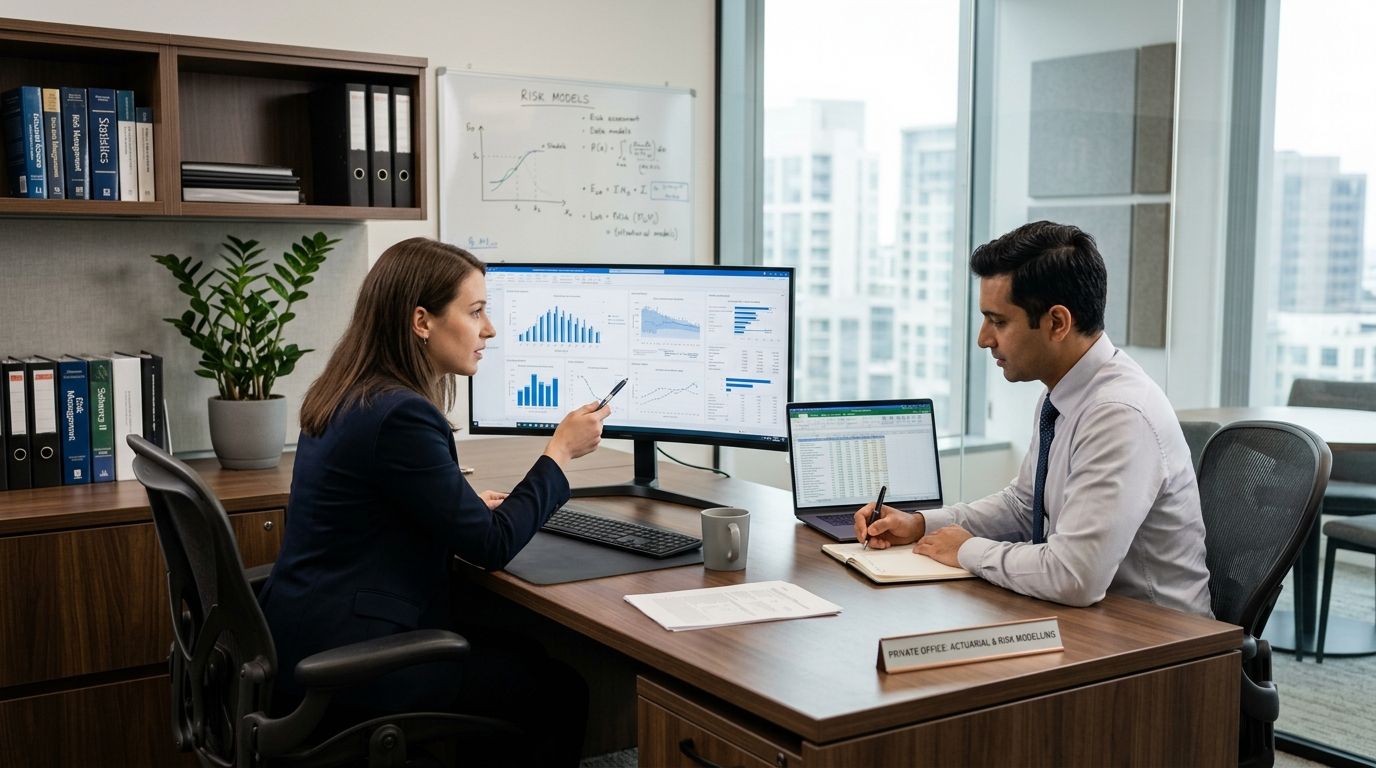
A private office for actuaries at Westend Business Hub in Werribee gives risk modelling consultants a lockable, quiet base to run long analytical sessions and handle client-sensitive data without the noise of an open coworking floor. Actuaries and risk modelling consultants need something most flexible workspace tenants don't: hours of uninterrupted focus for stochastic modelling, plus a room they can shut the door on when a client calls to discuss claims exposure or reserving assumptions.
- A private office for actuaries at Westend Business Hub gives risk modelling consultants a lockable room for confidential client data and long modelling sessions.
- Werribee-based actuaries and risk consultants use the private office plus meeting room hire together for client presentations.
- Compliance and risk consultants need document security a hot desk can't provide - a private office solves that.
- Upgrading from a virtual office to a private office is a common path as a solo actuary takes on more clients in 2026.
Why a private office matters for actuaries and risk modelling consultants
Actuarial work is confidential by nature. You're often modelling claims data, mortality tables, or reserving figures for insurers and super funds, and that data can't sit on a laptop screen visible to whoever's at the next hot desk. A private office for actuaries solves the confidentiality problem and the focus problem at the same time - a locked door means nobody glances at your spreadsheet, and a quiet room means your third hour of a Monte Carlo simulation doesn't get derailed by someone's phone call.
Risk modelling consultants also tend to work in bursts - deep solo modelling time followed by client meetings where you explain what the numbers mean. That rhythm doesn't suit a shared desk. It suits a private office you can leave your monitors set up in, paired with a meeting room booked only when you need it.
Assess your daily workflow before you commit
Before booking anything, work out what your week actually looks like. Most actuaries and risk consultants split time between modelling, client calls, and report writing, and each of those needs something different from the room.
- Count how many hours a week need total quiet versus how many are calls or meetings
- List the number of screens and the desk depth you need for your setup
- Check whether you need to leave sensitive files or hardware locked overnight
- Note how often clients visit versus how often you go to them
- Work out if you need a landline number or just a professional email footer
Secure a lockable, dedicated room
Once you know your pattern, a private office is the direct fix for the confidentiality issue a shared desk can't solve. Westend Business Hub's private office plans in Werribee give actuaries and risk modelling consultants a room with a door, not just a reserved desk in an open area.
- Choose a room sized for your monitor and paper file setup, not just a laptop
- Lock the door when you step out for a coffee or a meeting elsewhere
- Keep client files and hardware on-site instead of carrying them home each night
- Set up a permanent dual-monitor rig instead of packing up daily
- Ask about access hours if you model late or start early
An engineering or technical consultancy has near-identical needs - long solo analysis blocks broken by client check-ins - which is why the private office for engineering and technical consultancies plan follows the same logic.
Book meeting room access for client presentations
You don't present risk models from your desk. Clients want a proper room, a screen, and privacy for the conversation - especially when the numbers involve claims exposure or capital requirements they'd rather not discuss in a shared lounge.
- Book a room only for the hour or two you actually need it
- Use a screen or projector to walk through the model rather than emailing a deck cold
- Keep the room private enough that sensitive figures stay between you and the client
- Have water and basic AV ready so the meeting doesn't stall on logistics
- Book back-to-back slots on presentation-heavy weeks instead of one at a time
The meeting room hire for client presentations page covers what's available for exactly this kind of session.
Separate your business address from your home address
Actuarial consultants registering with professional bodies or issuing invoices need a business address that isn't a home address - clients and regulators both notice the difference. This is where a private office earns its keep beyond the desk itself: it comes with a real, professional Werribee business address you can put on invoices, contracts, and your ABN registration.
- Use the office address on invoices instead of a residential one
- List it as your registered business address for compliance paperwork
- Give clients a real place to send documents or courier packages
- Keep your home address off public business directories
- Update your Google Business Profile once the address is confirmed
Plan for growth instead of locking yourself in
Most actuarial and risk consulting practices start solo and add an analyst or two within a year or two. Plan the room size and membership terms with that in mind rather than optimising only for today's headcount.
- Ask whether the room can be resized as you add staff
- Keep contract terms short enough to adjust if your client load changes
- Budget for a second desk or a small team room before you actually need it
- Check if meeting room hours scale with your membership or need separate booking
- Review your setup every six months against actual usage, not assumptions
If you're still weighing a private office against a serviced suite or a home setup, the best serviced office alternatives for lean professional teams comparison is worth a read before you sign anything.
“If your model needs six uninterrupted hours, a shared desk near a coffee machine isn't the answer.”
Comparing your workspace options
| Option | Best for | Key limitation |
|---|---|---|
| Home office | Solo actuaries with no client visits | No separation between client data and household, no professional address |
| Hot desk / coworking | Occasional office days, early-stage consultants | No lockable storage, limited privacy for calls |
| Private office (Westend Business Hub) | Actuaries and risk consultants handling confidential client data daily | Fixed room size until you formally upgrade |
| Virtual office only | Solo consultants who mostly work from client sites | No physical desk when you do need quiet modelling time |
Verdict: a private office at Westend Business Hub is the right call for any actuary or risk modelling consultant handling confidential client data on a daily basis in 2026 - a virtual office alone doesn't give you the locked room, and a hot desk doesn't give you the privacy.
See a private office in Werribee
Walk through a lockable room sized for modelling work and client meetings.
Common mistakes actuaries and risk consultants make
- Working sensitive client data from a home desk shared with family. Confidentiality obligations don't pause because you're at home - a locked office removes the risk entirely.
- Booking a hot desk and expecting deep-focus modelling time. Open coworking floors are built for collaboration, not four-hour spreadsheet sessions.
- Skipping a proper meeting room for client presentations. Explaining a risk model over a laptop in a café undersells the work and the fee.
- Registering a business address that changes every time the lease does. Compliance paperwork and client trust both suffer when your address moves twice a year.
- Locking into a large private office before the client base justifies it. Start with the room you need now and plan the upgrade path, not the other way around.
FAQ
What's the best private office setup for a solo actuary in 2026?
A lockable private office with a dedicated desk for two monitors and access to a separate meeting room for client calls is the standard setup for a solo actuary in 2026. It keeps confidential modelling work separate from client-facing conversations.
Is a private office better than working from home for risk modelling consultants?
Yes, for anyone handling confidential client data daily - a private office keeps that data off a household laptop and gives you a professional business address for invoices and registration. Home offices work fine for very early-stage solo consultants with few client visits.
Do actuaries need a meeting room or just a desk?
Both, but not from the same booking. A private office covers the daily modelling work, and a separately booked meeting room covers client presentations where you need a screen and privacy for the conversation.
Can I use a Werribee private office address for professional registration?
Yes, a private office at Westend Business Hub comes with a real business address you can use on invoices, contracts, and registration paperwork instead of a home address.
How do I upgrade from a virtual office to a private office?
Most consultants start with a virtual office for the business address, then move into a private office once client volume justifies a dedicated room - the process is a straightforward plan change, not a full re-registration.
What size private office does a risk modelling consultant need?
A single-desk private office is enough for most solo actuaries, but budget for a second desk if you plan to add an analyst within the next year.
One last thing
The actuaries who get the most out of a private office aren't the ones who book the biggest room - they're the ones who pair a modest private office with occasional meeting room bookings instead of paying for permanent meeting space they use twice a month. Start small in 2026, size up when the client list actually demands it.


