
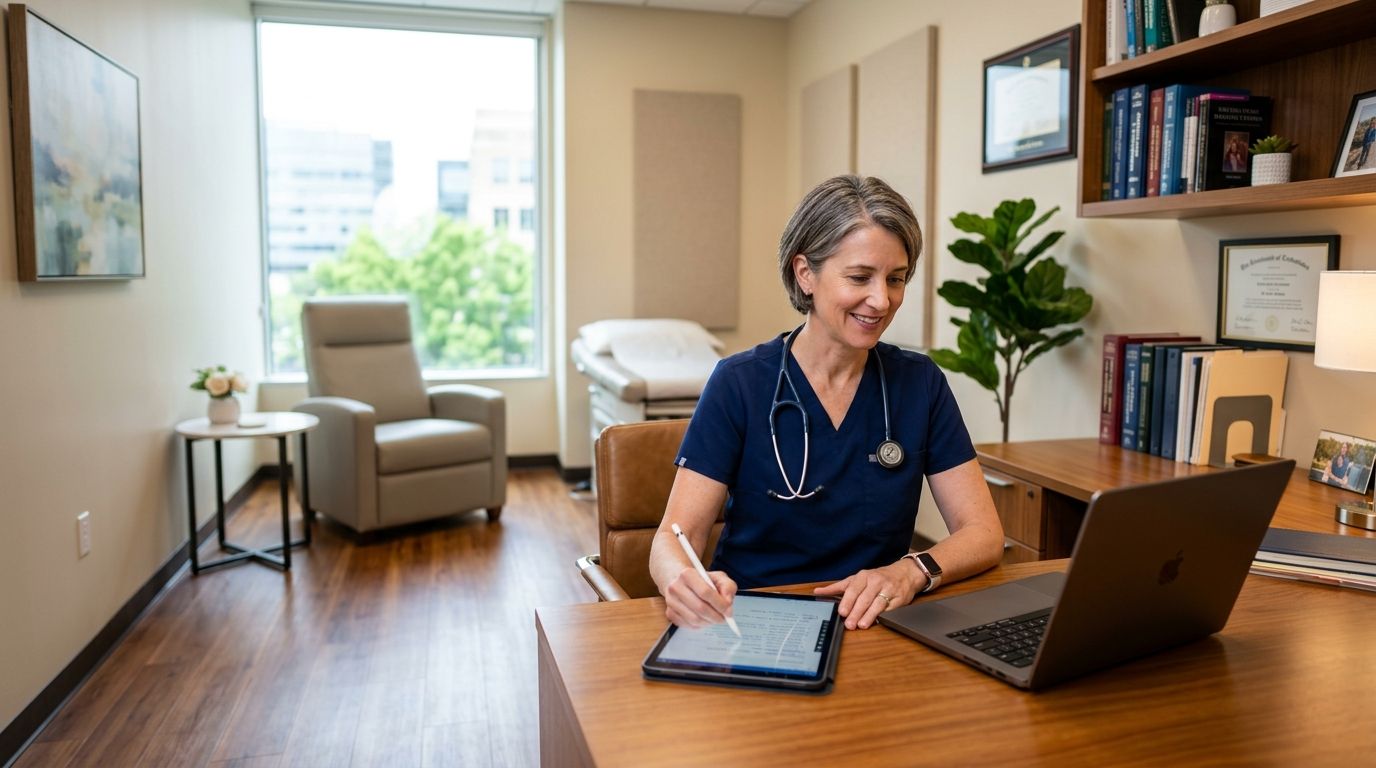
A private office for medical specialists in Werribee gives locum doctors, visiting consultants, and telehealth-only practitioners a lockable, soundproof room they can use between hospital shifts without signing a long commercial lease. The needs here are different from a typical small business tenant: patient confidentiality during calls, irregular booking patterns tied to rosters, and a professional address that survives a Medicare or AHPRA registration check.
- Westend Business Hub's private office for medical specialists suits locums and visiting consultants who need a soundproof room without a long lease.
- Confidentiality during patient calls matters more here than in most coworking use cases — check soundproofing before you book.
- A registered business address at Westend Business Hub can double as your AHPRA or Medicare correspondence address in 2026.
- Day-pass and month-to-month terms beat a fixed lease for locum doctors covering short-term placements.
Why a private office matters for medical specialists
Locum work runs on short notice. A specialist covering a six-week placement in Melbourne's west doesn't want to negotiate a 12-month commercial lease for a room they'll use three days a week. A private office solves the confidentiality problem that a shared desk or a cafe call can't: patient discussions, referral letters, and Medicare paperwork need a closed door, not headphones and a corner table.
The other driver is address stability. Specialists moving between hospitals, clinics, and telehealth blocks still need one registered address for AHPRA, insurers, and billing correspondence. A private office built for allied health practitioners gives that continuity even when the clinical work location changes every few weeks.
Define what your consultations actually require
Before comparing options, work out what a typical week looks like — this decides whether you need a full private office or something lighter.
- Number of patient or referrer calls per week that require a closed door
- Whether you need the room daily, or only on rostered clinic days
- Storage needs for equipment, files, or locked medical records
- Whether you'll ever run an in-person consult on site, not just calls
Compare a private office against a virtual-only setup
Many specialists start with a virtual address and only need a room occasionally. Others need the door closed most days. Get this wrong and you either overpay for space you don't use, or you're taking confidential calls from a shared bench.
- A virtual office covers mail and a registered address but no physical room
- A private office adds a lockable space you can book around your roster
- Locums covering multiple sites often need the address more than the desk
- Specialists running regular telehealth blocks usually need the room more than the address
Work out the true cost of a private office versus a virtual office before you commit — the gap is bigger than the sticker price suggests once you factor in occasional meeting room hire on top of a cheaper plan.
Book a soundproof room for patient-facing calls
Confidentiality isn't optional in this line of work. Before booking anything, confirm the room actually blocks sound — open-plan coworking floors with glass partitions look private and aren't.
- Ask specifically about wall construction, not just "private room" marketing copy
- Test a booking during a busy period, not an empty Tuesday morning
- Check whether the door locks from the inside during a session
- Confirm whether video calls are permitted, since some rooms are phone-only
Westend Business Hub's soundproof meeting rooms are built for exactly this kind of confidential call, not just client pitches.
Set up your mail and compliance address correctly
AHPRA renewals, Medicare provider correspondence, and indemnity insurance paperwork all need a stable postal address. Get this wrong once and a renewal notice sits at an old clinic address for weeks.
- Update your AHPRA registration address as soon as the office is active
- Set mail forwarding or scanning so nothing sits unopened for days
- Use the same address consistently across Medicare, insurers, and letterhead
- Confirm the address is a real staffed location, not a PO box, since some registrations reject those
Test the commute and parking before you sign anything
A private office that adds 40 minutes to a locum's day between hospital shifts defeats the point. Werribee's position in Melbourne's west matters here specifically because of drive times between hospital campuses.
- Check drive time from the hospitals or clinics you're rostered at this month
- Confirm on-site parking, since street parking near hospitals is often full
- Test peak-hour traffic, not the quiet 11am drive past on a viewing day
- Ask whether access is 24/7, since some locum shifts start before standard business hours
Negotiate terms that match a locum's schedule
A specialist covering three months at one hospital shouldn't be locked into a 12-month licence. Push for terms that match how locum work actually runs.
- Ask for month-to-month terms instead of a fixed annual lease
- Confirm whether you can pause the membership between placements
- Check if day passes are available for weeks you don't need the full room
- Get the cancellation notice period in writing before you sign
Calculate the true monthly cost, not just the headline rate
A private office quote rarely includes everything a specialist actually needs. Add meeting room hours for the occasional in-person consult, printing for referral letters, and mail handling before comparing two providers.
- Add any meeting room hire needed on top of the base private office rate
- Factor in printing and scanning for patient paperwork and referrals
- Include mail scanning if you're travelling between placements often
- Compare against the cost of a serviced-office alternative for a lean, one-person practice
See the room before you book
Tour a private office and soundproof meeting room in Werribee.
Comparing your options as a medical specialist or locum
| Option | Best for | Key limitation |
|---|---|---|
| Private office | Specialists needing daily confidential calls or storage | Fixed monthly commitment even in quieter weeks |
| Day pass / hot desk | Locums covering a single short placement | No guaranteed soundproof room without booking ahead |
| Virtual office only | Specialists who mainly need a registered address | No physical room for confidential calls |
| Meeting room hire by the hour | Occasional in-person consults or referrer meetings | Doesn't cover daily desk or storage needs |
A private office wins for any specialist running regular patient calls or holding physical records; a virtual office alone is enough if the work is entirely remote and occasional.
Common mistakes medical specialists make
- Booking an "open-plan private room" without testing sound leakage — glass walls and low partitions carry conversation further than they look like they should.
- Signing a 12-month term for a three-month placement — locum contracts end; office leases shouldn't outlast them.
- Forgetting to update AHPRA and Medicare correspondence addresses — renewal notices land at an empty clinic for weeks.
- Ignoring commute time between hospital sites — a great rate on the wrong side of Melbourne's west costs more in wasted driving than it saves.
- Skipping mail scanning while travelling between placements — physical mail that needs a signature or urgent action sits unread.
FAQ
What is a private office for medical specialists?
It's a lockable, soundproof room within a coworking site that gives specialists and locum doctors a confidential space for patient calls and paperwork without a long-term lease. Westend Business Hub offers this format in Werribee for practitioners moving between placements.
Is a private office better than a virtual office for a locum doctor?
A private office is better if you take confidential patient calls regularly or store physical records; a virtual office is enough if you only need a registered mailing address. Many locums use a virtual office for downtime months and a private office for active placements.
Can I use a coworking address for AHPRA registration?
Yes, provided the address is a real staffed location rather than a PO box — most registration bodies reject PO box addresses. Update your AHPRA and Medicare correspondence details as soon as the new office is active.
How soundproof does a room need to be for patient calls?
It needs to block normal conversation from being overheard outside a closed door, not just muffle it. Test the room during a busy period on-site rather than relying on marketing descriptions of "private" space.
Do I need a 12-month lease for a private office?
No — month-to-month terms are standard for coworking-style private offices and suit locum schedules better than a fixed annual lease. Confirm the cancellation notice period before signing.
What should a locum doctor budget for beyond the base office rate?
Add occasional meeting room hire for in-person consults, printing for referral letters, and mail scanning if you travel between placements. These extras change the real monthly cost more than the headline rate suggests.
Is Werribee a practical base for specialists covering multiple hospitals?
It works well for specialists rostered across Melbourne's west, provided drive times from each hospital campus are checked during peak hours before committing. Parking availability near the office matters as much as the address itself.
One last thing
The detail most specialists miss isn't the room, it's the registration paperwork trailing behind them. A locum covering three placements across 2026 can end up with AHPRA notices, insurer correspondence, and Medicare mail split across three old addresses if the registered address isn't updated each time the placement changes. Fix the address once, keep the room flexible, and the paperwork stops chasing you.


