
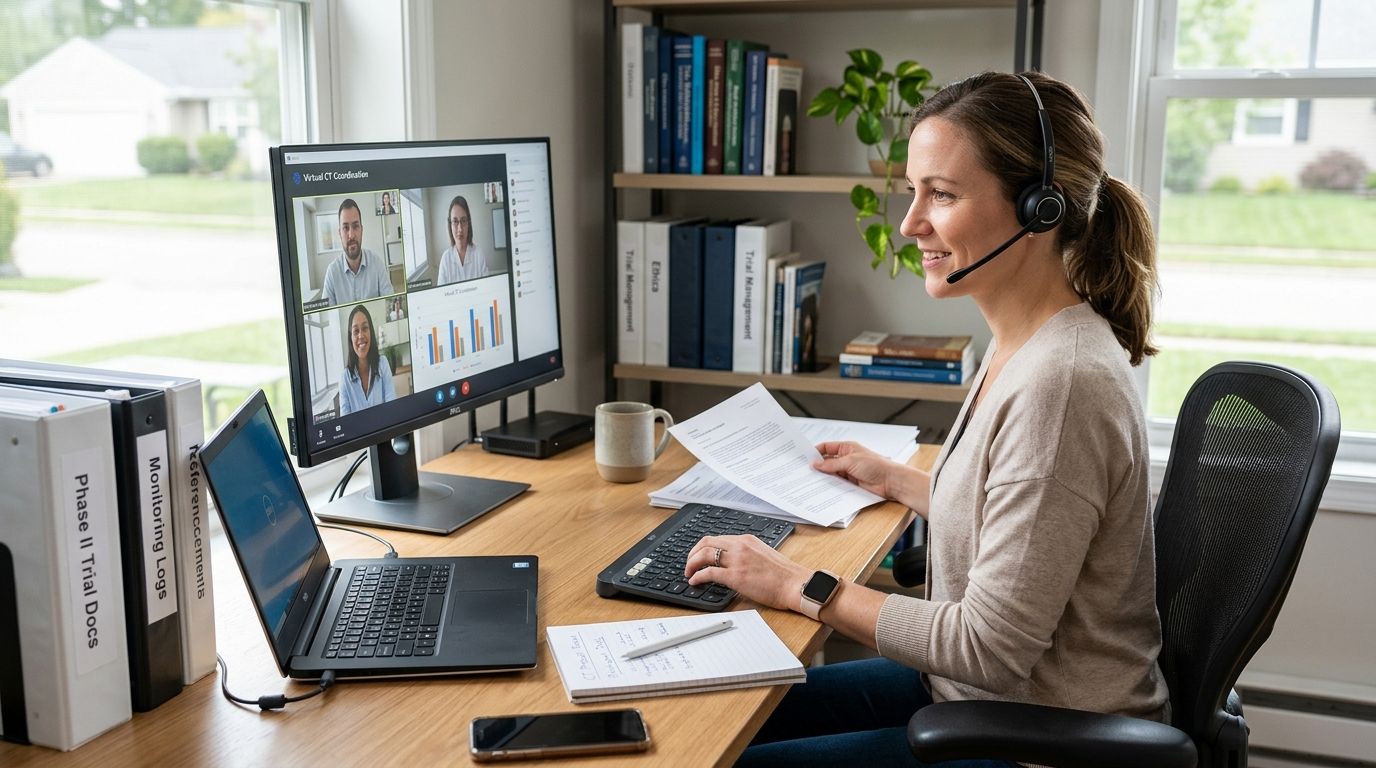
Virtual office for clinical trial coordinators is a registered business address, mail handling and meeting room service that lets site staff manage sponsor correspondence, ethics submissions and monitor visits without leasing dedicated clinic space. Coordinators running multiple sponsor contracts across shifting site locations need an address that stays fixed even when a trial closes out, plus a professional room for monitor visits a kitchen table can't provide.
- Virtual office for clinical trial coordinators gives a fixed Werribee business address for sponsor mail and ethics filings.
- Meeting room hire covers site initiation visits and monitor visits without booking clinic space.
- Mail scanning gets sponsor documents and HREC notices forwarded the day they arrive.
- Best for coordinators juggling more than one trial site or splitting time between home and sponsor offices.
- A private office suits coordinators storing confidential patient and sponsor documents long term.
Why a virtual office matters for clinical trial coordinators
Clinical trial coordination runs on paperwork that has to land somewhere reliable: sponsor contracts, Human Research Ethics Committee (HREC) correspondence, investigational product shipment notices, and Good Clinical Practice (GCP) audit records. A home address on a submission form works until the coordinator moves house or the trial reassigns a site, and then every document needs updating.
A registered address through Westend Business Hub in Werribee solves that by staying constant regardless of which sponsor contract is active this quarter. Coordinators who need somewhere to store confidential trial documents rather than just receive mail should look at the private office for allied health practitioners, which gives lockable storage alongside the address.
Monitor visits are the other pressure point. Sponsors expect a professional room for source data verification, not a cafe table where patient identifiers might be overheard. That's where meeting room access earns its keep for this segment specifically.
Set up your registered address before the first submission
Get the address locked in before it goes on an ethics form, a sponsor contract, or a Therapeutic Goods Administration (TGA) notification, because updating those documents mid-trial creates version-control headaches.
- Confirm the address is accepted for ABN and business registration through business.gov.au
- Use the same address consistently across every sponsor contract for a given trial
- Check the address can be listed on HREC submission paperwork before you submit
- Avoid listing a residential address if the trial might move sites during the study
- Keep a written record of when the address was activated, useful for audit trails
Set up mail handling for sponsor and ethics correspondence
Manually checking a PO box between site visits wastes time coordinators don't have during recruitment weeks. The free-first approach is simple: forward sponsor mail to a personal email inbox and check it daily.
- Flag sponsor envelopes and courier parcels for same-day attention, not end-of-week batching
- Separate personal mail from trial correspondence at the point of receipt
- Keep a signed log of investigational product shipment notices for GCP audit purposes
- Set a rule for urgent HREC notices that need action within 24-48 hours
When manual checking becomes unmanageable across two or three concurrent trials, mail scanned and emailed from a virtual office turns physical arrivals into a same-day digital copy, which matters when a monitor is waiting on a signed document before a site visit can proceed.
Book a meeting room for monitor and site initiation visits
Monitor visits and site initiation visits (SIVs) both need a room with a closed door, a table, and no foot traffic through patient discussions.
- Book the room only for the days a monitor is confirmed, not a standing weekly slot
- Confirm the room has a phone line or reliable mobile signal for sponsor dial-ins
- Print source documents in advance rather than relying on venue printers
- Check the room seats the monitor, the principal investigator, and the coordinator without crowding
Meeting room hire for client presentations covers this exact need in 2026: book by the session, not by the month, which suits a trial calendar that has quiet stretches between recruitment and close-out.
Add your address to contracts, invoices and your Google Business Profile
Sponsor payment schedules and site invoices need a consistent business address, and so does any public listing coordinators run for participant recruitment.
- List the same registered address on every sponsor invoice for the trial's duration
- Update the address on the site's Google Business Profile if recruitment materials link there
- Keep a single reference document showing which address version is current, for audits
- Confirm the address format matches what's on file with the ethics committee
Manage multiple concurrent trial sites without duplicate paperwork
Coordinators running two or three studies at once often end up with two or three different addresses on file, which is exactly the audit risk a fixed virtual office avoids.
- Standardise the address across every trial the coordinator manages, not just the newest one
- Keep separate mail folders per trial even when the physical address is shared
- Note the address consistently in each trial's regulatory binder
- Review the setup annually as new studies are added or older ones close out
Compare the workspace options for this segment
| Option | Best for | Key limitation |
|---|---|---|
| Virtual office address | Coordinators needing one fixed address across multiple sponsor contracts | No physical desk included; meeting rooms are booked separately |
| Private office | Coordinators storing confidential trial documents long term | Requires an ongoing desk commitment rather than pay-as-needed |
| Meeting room hire only | Coordinators who just need a room for monitor visits | Doesn't cover mail handling or a registered address |
| Home office | Coordinators on a single trial with no sponsor visits yet | Address changes if the coordinator relocates mid-study; not ideal for HREC paperwork |
Verdict: coordinators managing more than one active trial should pair a virtual office address with meeting room hire, not run either alone.
Set up your trial site address
Check current virtual office and meeting room plans for 2026.
Common mistakes clinical trial coordinators make
- Listing a home address on HREC paperwork, then having to amend every document when the coordinator moves house mid-study.
- Missing courier deliveries of investigational product notices because no one is rostered to sign for parcels on site visit days.
- Running monitor discussions in a cafe instead of a closed room, risking patient identifier confidentiality during source data review.
- Skipping a written mail-handling log, which becomes a problem the day a GCP auditor asks for a paper trail.
- Assuming a home office setup satisfies sponsor onboarding requirements that specifically ask for a business address, not a residential one.
FAQ
What is a virtual office for clinical trial coordinators?
It's a registered business address plus mail handling that a coordinator uses on sponsor contracts, ethics submissions, and invoices instead of a home address. It usually pairs with on-demand meeting room access for monitor visits.
Can I use a virtual office address for ethics committee submissions?
Yes, provided the address is confirmed on the trial's HREC paperwork before submission. Keep the address consistent across every document tied to that trial.
How does mail scanning work for sponsor correspondence?
Physical mail arriving at the registered address gets scanned and emailed the same day it's received, so a coordinator can act on an urgent HREC notice without visiting the site in person.
Is a virtual office enough for GCP compliance during monitor visits?
A virtual office covers the address and mail side; monitor visits still need a booked meeting room with a closed door for source data verification. Combine both rather than relying on the address alone.
Can I book a meeting room only for the days a monitor is on site?
Yes, meeting room hire is typically booked by the session rather than a standing weekly slot, which suits a trial calendar with quiet stretches between recruitment phases.
How much does a virtual office cost in 2026?
Pricing varies by plan and by how much mail handling or meeting room access is included, so check current plans directly rather than relying on last year's figures.
Do I need a private office instead of a virtual office for confidential trial documents?
If the coordinator stores physical patient or sponsor documents long term, a private office with lockable storage is the better fit than a virtual address alone.
Can multiple trial sites share one virtual office address?
Yes, coordinators running several concurrent studies can standardise on one address across all of them, provided each trial's regulatory binder reflects the same registered address.
One last thing
The detail most coordinators miss until an audit forces the question: keep a dated log of every scanned document from the virtual office address, separate from the trial's regulatory binder. Auditors in 2026 are asking for chain-of-custody evidence on correspondence, not just source documents, and a mail-handling log closes that gap before it becomes a finding.


